If you spend enough time around audio forums, YouTube reviews, Reddit threads, or comment sections, you start to notice something very quickly.
A lot of people talk about “better sound” with huge confidence.
But a surprising amount of that advice is either exaggerated, misunderstood, or so context dependent that it becomes useless for normal people trying to improve their setup.
One person will tell you that you need lossless audio or you are “missing everything.” Another will swear that a £200 cable transformed their system. Someone else will insist that unless your speakers are perfectly flat, acoustically treated, and positioned to the millimetre, there is no point even trying.
And honestly, this kind of stuff puts people off audio.
Because the truth is, great sound does matter. But the things that improve it most are usually not the flashy, expensive, overhyped upgrades people obsess over.
So this article is about cutting through that.
Not from the angle of trying to sell you gear, but from the angle of what genuinely changes your listening experience in the real world.
Because some things in audio really do make a huge difference.
And some things barely matter at all.
Why Audio Quality Gets Confusing So Fast
Audio is one of those areas where objective facts and subjective experience constantly overlap.
That is part of what makes it interesting, but it is also what makes it easy to get lost.
You can measure frequency response, distortion, dynamic range, noise floor, stereo imaging, latency, and all sorts of technical characteristics. Those things are real. They matter.
But then there is also perception.
The human brain is incredibly suggestible. If something is more expensive, heavier, marketed as premium, or recommended by someone who sounds authoritative, we are naturally more likely to believe it sounds better. That does not make people stupid. It just means expectation bias is real.
And audio has a perfect storm of conditions for that bias to thrive.
Most comparisons are not level matched. Most people do not test things blindly. Most listening happens in wildly different rooms, on different systems, at different volumes, and with different source material. So people often describe tiny differences as massive ones, or they confuse preference with accuracy.
That is why it helps to start from a more grounded question:
What changes the sound in a way that most people will actually notice?
That is where the useful conversation begins.
The Biggest Things That Actually Make a Difference
Let’s start with the stuff that really matters.
These are the areas where changing one variable can produce a very obvious result, even for non-audio people.
1. Speakers and Headphones Matter More Than Almost Anything Else
If there is one area where your money and attention matter most, it is here.
Your speakers or headphones are the final translation point between the audio signal and your ears. They are literally the part of the chain that turns electrical information into physical sound. So naturally, they shape your experience more dramatically than almost anything upstream.
This is why a decent pair of speakers connected in a sensible way will usually outperform an ultra-expensive source feeding cheap speakers.
It is also why people sometimes waste money upgrading the wrong thing.
They buy a fancy DAC, a premium streaming service, or boutique cables while listening through tiny Bluetooth speakers or weak headphones with poor tuning. At that point, the system is limited by the transducer, not the source.
A better speaker or headphone setup can improve:
- tonal balance
- clarity
- bass extension
- stereo imaging
- detail retrieval
- dynamics
- listening fatigue
- sense of space
And importantly, these improvements are usually not subtle.
You do not need golden ears to hear when one pair of headphones sounds boxy, harsh, muddy, or thin compared to another. You also do not need expert training to hear when a proper pair of speakers fills a room in a natural way compared to a cheap, narrow, shouty setup.
This is one of the first places where the “what actually matters” conversation becomes practical.
If someone has a limited budget, moving from poor speakers to well-designed speakers is often a night and day upgrade.
Moving from a decent DAC to a slightly better DAC usually is not.
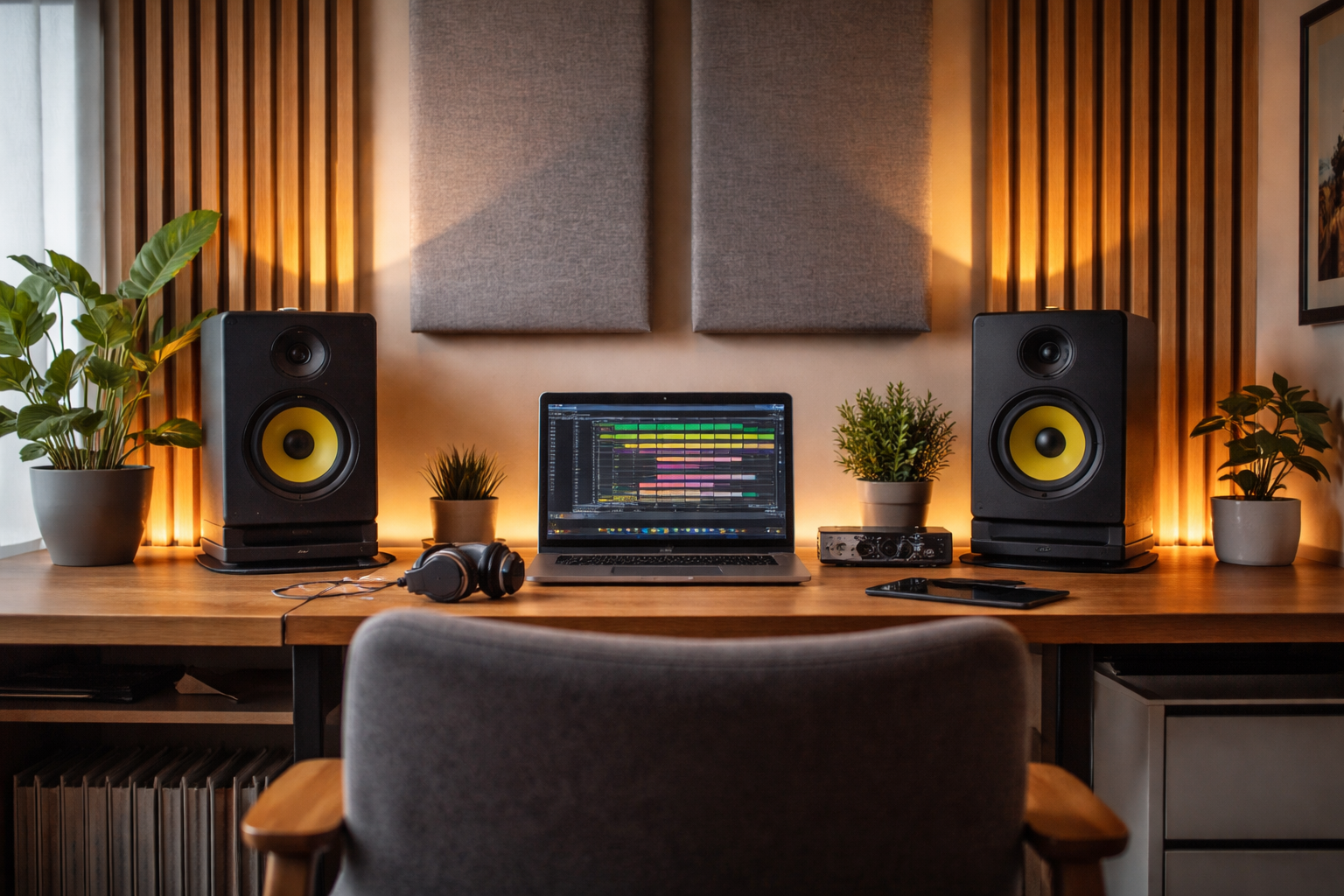
2. Speaker Placement Is Ridiculously Important
This is probably the most underrated audio topic by normal listeners.
People will spend hundreds upgrading gear, then place their speakers in the worst possible position and wonder why everything sounds average.
Speaker placement affects audio quality far more than many people realise because sound is not just coming directly from the speakers to your ears. It is also bouncing around the room, reflecting off walls, desks, floors, ceilings, and furniture.
A few bad placement choices can damage:
- bass balance
- stereo image
- vocal clarity
- centre image stability
- perceived detail
- overall realism
For example, if your speakers are shoved right against a wall, bass can become bloated or uneven. If one speaker is closer to a side wall than the other, the stereo image can feel pulled to one side. If your speakers are too wide apart, the middle can feel hollow. If they are too low, too high, or angled badly, you lose focus and coherence.
Even basic improvements can make a huge difference:
- placing speakers symmetrically
- aiming them toward your listening position
- keeping them at roughly ear height
- pulling them away from walls where possible
- avoiding corners
- creating a sensible listening triangle
This is one of those things that sounds boring compared to buying a new gadget, but it works.
In many home setups, better placement gives more improvement than any electronics upgrade.
That is not an exaggeration.
3. The Room Matters More Than People Want to Admit
This is the big one.
You are not just hearing your speakers. You are hearing your room.
And in speaker-based listening, the room is often one of the most powerful influences on what you perceive.
Hard floors, bare walls, glass surfaces, alcoves, large empty spaces, reflective desks, and poor symmetry can all shape your sound in major ways. Low frequencies build up in some areas and disappear in others. Reflections smear detail. Certain notes can sound massively exaggerated while others vanish.
This is why the same pair of speakers can sound brilliant in one room and disappointing in another.
It is also why online reviews can only tell you so much. A speaker that sounds balanced in a treated room might sound bright in a reflective living room. A model with generous bass might sound amazing in one environment and horribly boomy in another.
People often underestimate room impact because it is less visible than gear. You can hold a DAC in your hand. You cannot as easily point to a room mode or a reflection problem and say, “that is the issue.”
But it is there.
This is especially important in smaller rooms, desk setups, bedrooms, and multi-use living spaces where speakers are close to boundaries and surfaces.
Even without full acoustic treatment, small room changes can help:
- rugs on reflective floors
- curtains on large glass areas
- bookshelves or soft furnishings to break up reflections
- avoiding symmetrical bare surfaces
- moving your listening position away from the exact centre of the room
- not placing your head right against the back wall
People love to chase microscopic detail in equipment while listening in rooms that are actively working against them.
Fix the room even a little, and the benefits are often immediate.
4. Bad Source Material Limits Everything
This one matters, but needs nuance.
The quality of the original recording, mix, and master matters enormously.
A beautifully recorded track with good dynamic range, thoughtful balance, and clean mastering will sound impressive on lots of systems.
A badly recorded, crushed, harsh, distorted, or over-compressed track will never magically become amazing just because your system is expensive.
This is where a lot of confusion begins around “detail.”
Sometimes a better system is not making the music better. It is just making flaws easier to hear.
And sometimes people blame their setup for problems that are actually in the recording.
If a vocal sounds sharp and brittle, or a kick feels flat and lifeless, that does not always mean your speakers are bad. It may just be the source.
This is also why you should never judge audio quality based on one or two songs. Some music is recorded and mastered far better than others.
A good listening test uses familiar tracks across different genres and production styles.
Because source quality does matter.
But not in the simplistic way people often frame it.
5. Volume Changes Perception More Than Most People Realise
This is another huge one.
Humans do not hear all frequencies equally at all volumes.
At lower listening levels, bass and treble often feel less pronounced. As volume increases, the sound can seem fuller, more exciting, and more detailed, even when nothing else has changed.
This creates one of the most common traps in audio comparisons.
The slightly louder option often gets perceived as “better.”
Not because it is genuinely more accurate, but because our ears interpret the added level as more impressive.
This is why honest comparisons matter. If two devices are not volume matched closely, impressions become unreliable very quickly.
It is also why people can mistake a louder speaker, hotter master, or more aggressive EQ for superior quality.
Sometimes it is not better.
It is just louder.
That does not mean louder is always bad. Plenty of people prefer a more energetic presentation. But preference and true improvement are not the same thing.
Understanding this helps you avoid being misled by demos, showrooms, or quick A/B tests.
What Matters Less Than People Think
Now for the uncomfortable part.
These are the areas that often get huge attention online, despite making a much smaller difference for most listeners.
1. Ultra-Expensive Cables
This is where people get defensive, but it needs saying clearly.
In a normal, competently set up audio system, cables are rarely the game changer people claim.
Do cables matter at all?
Yes, in the sense that they need to work properly, be built reasonably well, have the right connectors, and avoid obvious issues like poor shielding, loose terminations, or signal problems.
But once you have a decent cable that does its job correctly, you are usually well past the point of dramatic sonic transformation.
A cable can absolutely be bad.
A cable can fail.
A cable can introduce noise in some situations.
But the leap from “working cable” to “luxury cable changed my whole system” is where things get shaky.
The reason this topic gets so inflated is simple. Cables are easy to market. They feel premium. They can be beautifully packaged. They are easier to swap than speakers. And once someone has spent a lot on them, they are naturally motivated to hear a difference.
That does not automatically mean they are lying. It just means human perception is messy.
In practical terms, buy cables that are:
- reliable
- appropriately shielded
- the correct length
- well made
- from sensible brands
Then stop worrying about them.
2. Lossless Audio for Everyone, All the Time
This is another one that gets oversimplified.
Lossless audio is technically better than lossy audio. That part is true.
If you compare an uncompressed or lossless file to a low bitrate compressed version, there can absolutely be audible differences.
But the real-world question is not “is lossless superior on paper?”
It is “how audible is that difference in normal listening?”
And for many people, on many systems, in many environments, the answer is: not very.
Especially when comparing high bitrate lossy audio to lossless.
A well-encoded lossy file can sound extremely close to its lossless equivalent, to the point where many listeners will struggle to tell the difference consistently in blind tests, especially outside quiet, focused listening conditions.
That does not mean lossless is pointless.
It can be worth having if:
- you want the best available source quality
- you listen critically on revealing equipment
- you archive or edit music
- you simply like knowing you are getting the full file
But some people talk about lossless as though switching from standard streaming to lossless will completely transform a basic setup.
Usually, it will not.
If your speakers are poor, your room is untreated, your placement is bad, and your listening environment is noisy, lossless is not the missing piece.
In most cases, speaker quality and room setup will dwarf the difference.
3. DAC Upgrades Beyond a Reasonable Baseline
DAC stands for digital-to-analog converter, and yes, every digital audio system needs one somewhere in the chain.
But DAC discussion online can get wildly disproportionate.
A bad DAC implementation can absolutely cause problems. Cheap built-in outputs can sometimes introduce noise, distortion, interference, or weak performance. So moving from a genuinely poor source to a solid external DAC can be worthwhile.
But once you cross into the territory of a competent DAC with clean performance, the gains often become much smaller than the marketing suggests.
This is where diminishing returns hit hard.
People sometimes behave as if changing DACs is like changing speakers.
It is not.
In a well-functioning system, swapping from one decent DAC to another decent DAC is usually nowhere near as dramatic as changing speakers, changing headphones, fixing placement, or improving the room.
This is not anti-DAC. It is just about proportion.
If your current output is noisy, weak, or unreliable, then yes, upgrading the DAC or interface may help.
If your existing DAC is already transparent enough for the job, it may not be the magic upgrade the internet promised.
4. Obsessing Over Extreme File Specs
There is a certain type of audio discussion that becomes obsessed with sample rates, bit depth, and huge hi-res numbers in a way that sounds impressive but often misses the bigger picture.
Higher sample rates and higher bit depths absolutely have their place, especially in recording and production workflows.
But for playback alone, the practical listening benefit is often overstated.
For normal listening, the quality of the master matters far more than whether the file is labelled 24-bit/192 kHz.
A well-mastered standard-resolution track will often sound better than a poorly mastered hi-res file.
And that is the key point.
People sometimes chase format specs when what they are really responding to is a different master.
Not the numbers themselves.
The label can distract from what actually matters.
5. Chasing “Detail” Without Understanding Tonal Balance
A lot of people say they want more detail when what they actually mean is they want more treble or a brighter presentation.
This is important, because not all “detailed” sound is genuinely more informative.
Sometimes a system sounds more detailed simply because upper frequencies are pushed forward. That can make vocals, cymbals, reverb tails, and transients seem clearer at first. But over time it can also become fatiguing, sharp, or unnatural.
True detail is not just brightness.
It is the ability to reveal texture, layering, decay, subtle dynamics, space, and separation without sounding forced.
That kind of quality is harder to achieve and usually involves better driver design, tuning, distortion control, and system balance, not just a tilted frequency response.
So if a product sounds immediately “more detailed,” it is worth asking whether it is truly resolving more information or just emphasising a certain part of the spectrum.
That distinction matters.
The Biggest Myth in Audio: More Expensive Means Better Sound
Price and quality are related sometimes, but not always in a simple or linear way.
Past a certain point, audio becomes a game of marginal gains, brand positioning, luxury materials, aesthetics, niche preferences, and collector psychology.
That does not mean high-end products are fake.
Some are genuinely excellent.
But the jump from entry-level to good mid-range is usually much more noticeable than the jump from good mid-range to ultra-premium.
And that matters for readers because it keeps expectations realistic.
There is no shame in building a sensible setup.
You do not need to spend absurd money to enjoy music properly.
In fact, some of the best audio advice is not about chasing perfection at all. It is about removing obvious weaknesses and getting the fundamentals right.
That is where the real value is.
What I Would Prioritise in the Real World
If someone asked me how to improve their sound without getting dragged into internet nonsense, I would usually suggest this order of thinking:
Start with the listening device
Your speakers or headphones shape the experience massively. Get something genuinely decent before obsessing over the rest.
Fix placement
A good setup badly placed can sound mediocre. A decent setup well placed can sound surprisingly good.
Consider the room
You do not need a studio, but you do need to stop the room from sabotaging everything.
Use good source material
Not because you need audiophile theatre, but because bad recordings stay bad.
Make fair comparisons
Volume match properly. Use familiar tracks. Take your time. Ignore hype.
Only then think about smaller upgrades
DACs, codecs, streaming tiers, accessories, and secondary refinements should come after the fundamentals, not before them.
That order is not as glamorous as social media makes audio seem.
But it is far closer to the truth.
How to Tell if an Upgrade Is Actually Real
One of the best habits you can build in audio is learning to question your first impression.
Not to become cynical, but to become more accurate.
When testing any change, ask yourself:
- Is it actually better, or just louder?
- Is it more detailed, or just brighter?
- Is it more impressive at first, but more fatiguing over time?
- Am I hearing a real difference, or am I expecting one?
- Did I change the thing that matters most, or just the easiest thing to swap?
That mindset saves money and helps you build a system based on reality instead of marketing.
Because real audio quality is not about joining a cult of specifications or pretending every upgrade is profound.
It is about understanding what moves the needle and what mostly exists as noise.
Final Thoughts
The truth about audio quality is not that everything is a scam.
And it is not that every tiny difference is life changing either.
It is that some parts of the chain matter massively, and some parts matter far less than the internet would have you believe.
If you care about better sound, focus on the things that create the biggest audible gains:
- better speakers or headphones
- better placement
- a better room
- better recordings
- honest comparisons
That is where the meaningful improvements live.
Not in endless spec chasing.
Not in luxury cable mythology.
Not in pretending every upgrade unlocked hidden dimensions in your favourite album.
Good audio does not need to be mysterious.
Most of the time, it just needs a bit more honesty.